Presentation
Dialectal diminutives: morphological analysis and digital mapping
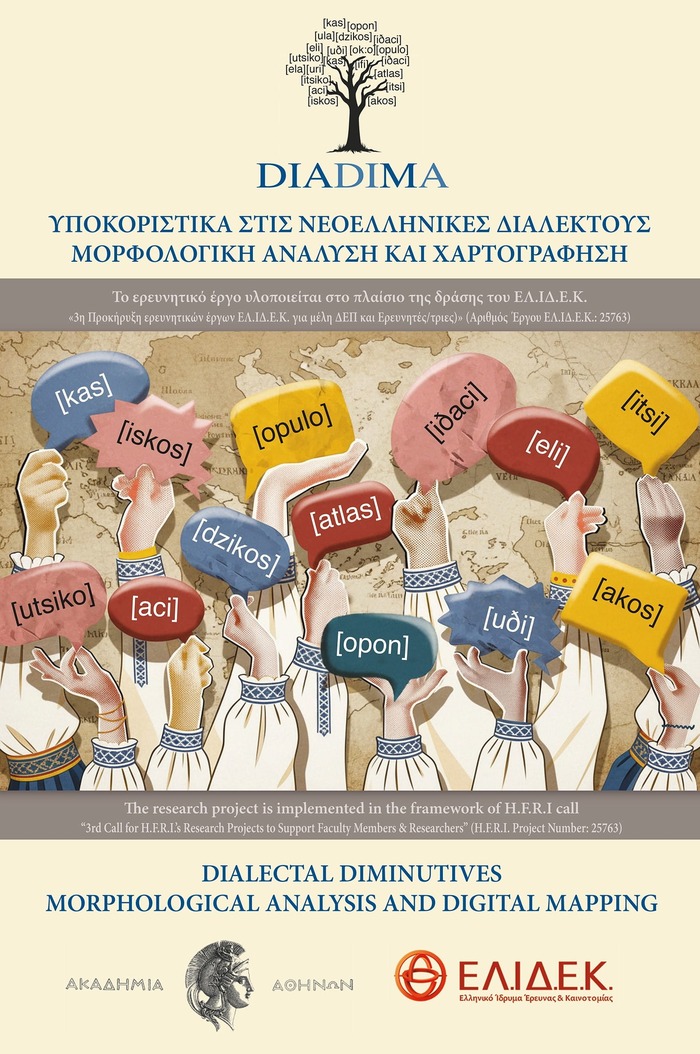
The DIADIMA project is funded by the Hellenic Foundation for Research and Innovation (ELIDEK) as part of the 3rd Call to Support Faculty Members and Researchers. It has a duration of four years (2025–2029) and aims to record and analyze the formation of diminutives in all Modern Greek dialectal varieties. The main objective of the program is (through the use of modern technological tools for the study of language) to create, for the first time in Greece, an open-access electronic dialectal atlas of Modern Greek diminutive suffixation and an online database of diminutive suffixes.
Evaluative morphology is the branch of linguistics that deals with the formation of diminutive, augmentative, and positive or negative evaluative structures. Modern Greek (MG) evaluative structures are mainly formed by suffixation. Diminutive suffixes occupy a central position in MG suffixation and constitute a key differentiating feature of Modern Greek dialects, often marking local identity. Based on the above, the DIADIMA research questions include:
- At the theoretical level: the structure and function of diminutive suffixes (selection restrictions, morphological limits, diversity in form and function)
- At the dialectological level: the geographical distribution and possible use of diminutive suffixes as isoglosses or criteria for categorizing Modern Greek dialects
The program utilizes modern technological tools with the aim of creating, for the first time in Greece, an open-access electronic dialectal atlas of Modern Greek diminutive suffixes and an online database of diminutive suffixes. In this context, the implementation of DIADIMA is expected to contribute significantly to the recording and preservation of a fundamental part of Greek cultural heritage, and more specifically, part of the richness of Modern Greek dialects. In addition, the information and data that will result from the program’s research activities will help answer fundamental questions about the morphological processes of diminutive formation.
The main goals of the DIADIMA project are:
- To promote the Greek linguistic heritage
- To deepen knowledge of Modern Greek linguistic diversity, based on a rich and unexplored body of data that will provide new insights into dialectal diversity and change
- To strengthen interdisciplinary research by joining forces with information technology
- To support new and more experienced scholars, especially in terms of acquiring innovative research skills in the field of dialectology
- To increase the prospects for the development of new techniques and products in the field of Modern Greek dialectology